


The US military announced on Wednesday that it completed the withdrawal of all American troops from Iraq, ending a 12-year mission to fight the so-called Islamic State group.
The move prompted US President Donald Trump to hail the conclusion of “a very expensive excursion into Hell”.
The last US troops left an air base in northern Iraq under a deal between Baghdad and Washington.
Mr Trump described the withdrawal by a September 30 deadline as “orderly” and said in a social media post: “It has been a long time, with very bad decision-making that got us involved in this quagmire in the first place, but soon, that will be part of history.”
"Today, I am pleased to announce, that the last American Forces are leaving Iraq!… This Day is a victory for the United States, a victory for Iraq, and a decisive victory over ISIS, which has been completely decimated by the Trump Administration…" – President Donald J. Trump… pic.twitter.com/ueDk3noxSU
— The White House (@WhiteHouse) September 30, 2026
He said the shift was a victory for the US, Iraq and a sign of victory over IS.
The withdrawal, agreed on two years ago, comes against the backdrop of the ongoing war between the United States and Iran that has also sometimes spilled over into Iraq, with Iran-backed militias firing on US troops and the US striking the groups’ strongholds.
Mr Trump’s comments came as own decision earlier this year to launch the war with Iran has been compared to the Iraq war for its undefined mission as it nears its seventh month.
In recent years, Washington has appeared to seek to shift its focus from the Middle East toward Asia, but that shift has been inconsistent, with the Pentagon alternating between reducing its Middle East presence and then finding itself engaging in new conflicts — including the ongoing war in Iran.
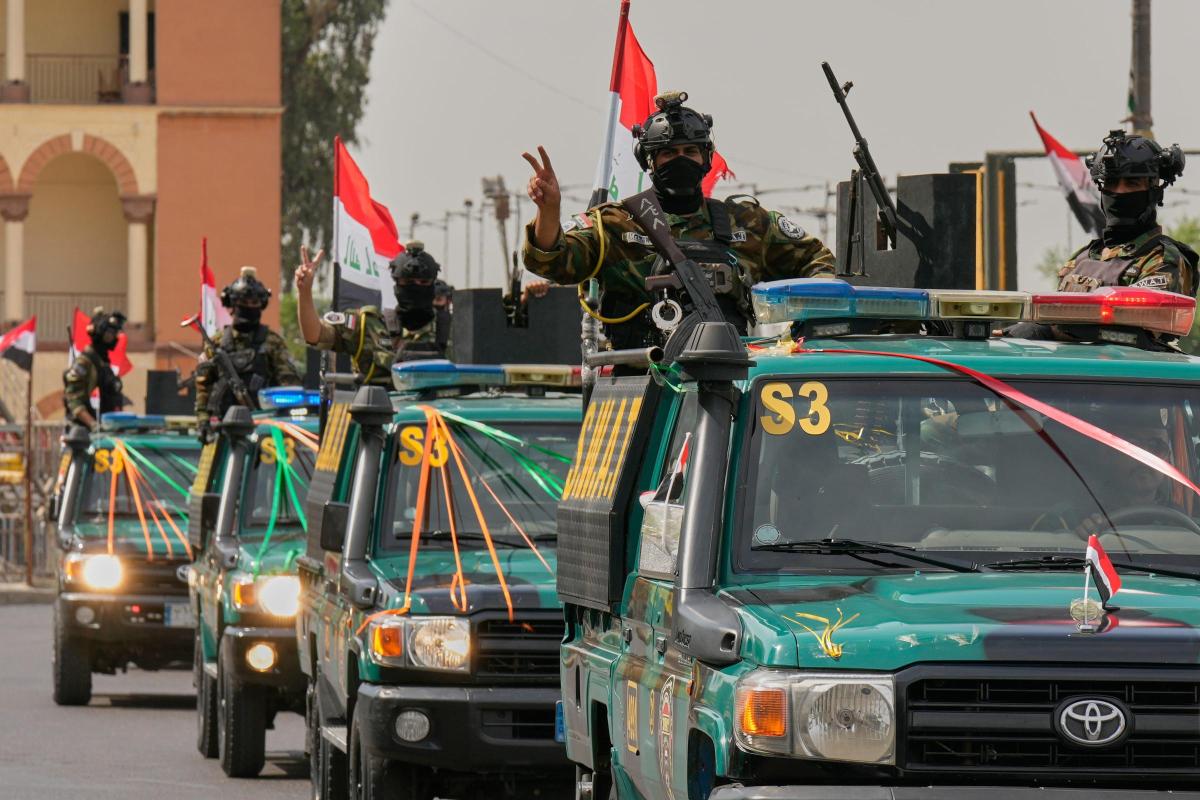
Baghdad touted the end of the US mission as a sign of the country’s increasing strength and sovereignty.

The withdrawal was also celebrated by Iran-backed groups but raised concerns among some other Iraqis, particularly in the Kurdish region, where many fear a resurgence of the Islamic State group as well as more attacks by Iran-linked groups, possibly emboldened by the departure of US forces.
Meanwhile, questions loom around the future of the Iraqi militias, which the Baghdad government has sought to disarm, with little success so far.
Pentagon spokesperson Sean Parnell said in a statement that US troops and equipment had completed an “orderly departure” from the air base in Irbil, in northern Iraq’s semi-autonomous Kurdish region.
“This milestone reflects the success of a 12-year campaign that defeated ISIS as an organised military threat in Iraq and across the region,” he said.
“It also marks a transition from a wartime coalition mission to an Iraqi-led security effort supported by a more normal bilateral security relationship.”
He added that the US military “will continue to provide targeted training and intelligence support to our Iraqi partners”.

Iraqi Prime Minister Ali al-Zaidi presided over the handover ceremony and described the US withdrawal as the beginning of a “new phase, one defined by Iraq’s sovereignty, the strength of its institutions, the readiness of its forces, the unity of its decision-making, and balanced partnerships with its friends”.
He said Iraqi security forces will continue the fight against IS and the government will ensure that non-state groups no longer hold weapons.
US troops invaded Iraq in 2003 to topple Saddam Hussein. They departed in 2011, but three years later, Iraqi authorities invited a smaller US-led mission to fight the Islamic State group, which had rampaged across Iraq, seizing large swaths of territory.
With the extremist group reduced to scattered sleeper cells, Washington and Baghdad agreed in 2024 to wind the mission down.
US troops pulled out of bases in most areas of Iraq last year but maintained a small presence of hundreds of troops in the semi-autonomous northern Kurdish region.
Bases there have regularly come under attack since the US and Israel launched their war against Iran on February 28. Iran-backed Iraqi militias also have coordinated with Yemen’s Houthi rebels to attack Saudi Arabia.


Share